Vision
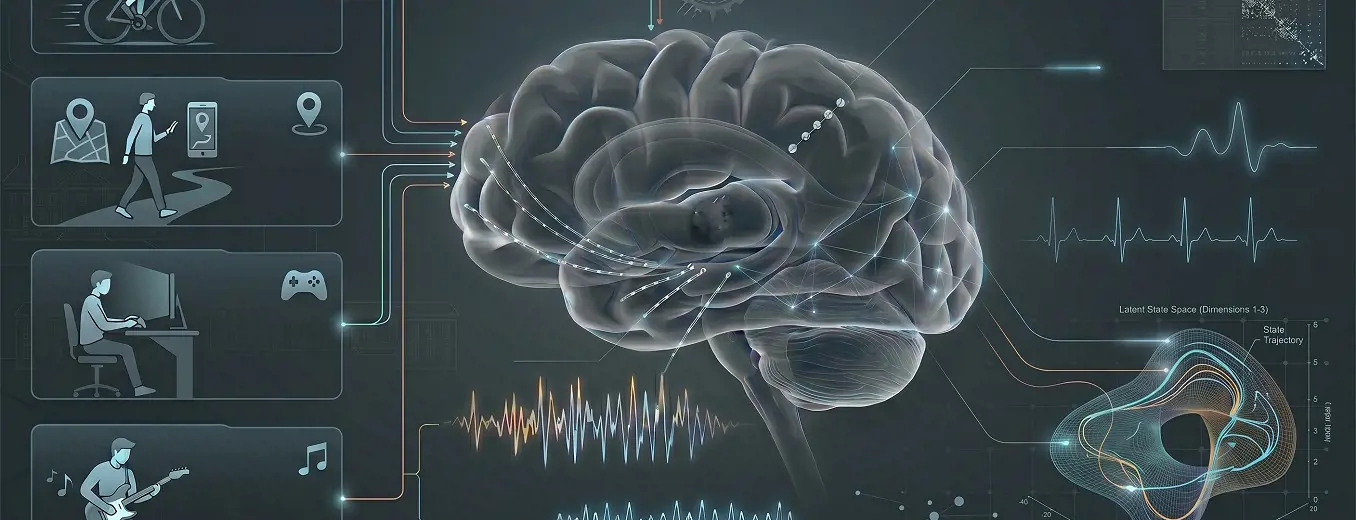
The Human Systems Neurophysiology Lab studies how the human brain represents and updates information to guide learning, decision-making, and memory. We investigate both the normal operation of these processes and their disruption in neurological and psychiatric conditions, with the aim of identifying mechanisms that can be targeted for intervention. Our work focuses on the neural circuits underlying reinforcement learning, cognitive control, and memory representations, and how these processes are shaped by neuromodulatory systems.
The lab is embedded within a functional neurosurgery environment, providing a unique opportunity to study human brain function directly in patients undergoing invasive monitoring and neuromodulation therapies, including deep brain stimulation. We leverage intracranial electrophysiology, including single-neuron and population-level recordings, to examine neural activity at high spatial and temporal resolution in clinical settings.
By combining computational modeling with human electrophysiology, we aim to bridge theoretical accounts of behavior with their implementation in neural circuits. A central goal of the lab is to translate these insights into improved, circuit-guided neuromodulation strategies for neurological and psychiatric disorders.
Principal Investigator

Dr. Genela Morris
Team
Dr. Daniel Poliakov
MSc: Tziona NessAiver
MSc: Manar Iraqe
PhD (joint supervision):
Neta Hazut (current)
Shai Abramson (former)
Functional Neurosurgery
Prof. Ido Strauss
Shani Ben-Valid
Dr. Amir Banner
Neurology – Movement Disorders
Dr. Vered Livneh
Neurology – Epilepsy
Dr. Lilac Golstein
Neurology – Research
Dr. Inbal Maidan
Prof. Yuval Nir (Sagol Brain Institute)
Prof. Hagai Bergman (Hebrew University)
Prof. Rony Paz (Weizmann Institute)
Prof. Dori Derdikman (Technion)
Dr. Omer Linkovski (Bar-Ilan University)
Prof. Avi Mendelsohn (University of Haifa)
Funding



Research – Active Research Areas
We study human brain activity directly in patients undergoing invasive monitoring and neurosurgical interventions, including deep brain stimulation and intracranial recordings in the epilepsy monitoring unit. Using high-resolution electrophysiology, including single-neuron and population-level recordings, we characterize neural activity across cortical and subcortical circuits in neurological disorders such as Parkinson’s disease and epilepsy. A central goal of this work is to identify circuit-level biomarkers that can guide and improve neuromodulation therapies, including optimization of electrode placement, stimulation parameters, and patient-specific targeting strategies.
Building on our clinical and neurophysiological work, we develop approaches for circuit-guided neuromodulation. A major focus of the lab is the development of adaptive (closed-loop) deep brain stimulation strategies that use neural signals to dynamically adjust stimulation in real time. In parallel, we investigate large-scale brain connectivity in human patients using intracranial recordings, with the goal of understanding how interactions between regions such as the hippocampus, thalamus, and cortex support cognition and are disrupted in disease. We also develop methods for high-resolution mapping of therapeutic targets, integrating electrophysiology, imaging, and clinical outcomes to improve precision in functional neurosurgery.
We investigate how the human brain represents and updates information to support learning, decision-making, and memory within a reinforcement learning framework. Using intracranial recordings, we examine how key variables such as value, prediction error, uncertainty, confidence, attentional state, and decision biases are encoded across neuronal populations, and how these signals interact to guide behavior. In parallel, we study how the brain constructs and maintains representations of complex environments, with a focus on the hippocampus and its interactions with cortical and subcortical regions. Current work examines how task-relevant features are selectively encoded and how neural representations evolve over time, supporting learning, generalization, and flexible behavior.
We study how neural representations are shaped by learning and by changes in internal brain state, with a particular interest in the role of neuromodulatory systems. Previous work from the lab in animal models showed that neuromodulatory influences can strongly affect which features of an experience are encoded, how task-relevant representations emerge, and how stable or dynamic these representations remain over time. These findings provide a mechanistic framework for our current human studies, which examine related questions in intracranial recordings from patients with movement disorders, particularly Parkinson’s disease, and, where possible, in relation to clinical manipulations such as dopaminergic medication and neuromodulation.
Publication Highlights
Selected publications on neural representations, learning and neuromodulation in health and disease:
- Khatib D., Ratzon A., Sellevoll M., Barak O., Morris G., Derdikman D.
Active experience, not time, determines within-day representational drift in dorsal CA1.
Neuron, 2023 - Reitich-Stolero T., Aberg K.C., Halperin D., Ariel C., Morris G., Goldstein L., Fahoum F., Strauss I., Paz R.
Rate and noise in human amygdala drive increased exploration in aversive learning.
Nature, 2025 - Reitich-Stolero T., Halperin D., Morris G., Goldstein L., Bergman L., Fahoum F., Strauss I., Paz R.
Aversive generalization in human amygdala neurons.
Current Biology, 2025 - Naivelt R., Zutta M., Katzir Z., Monteoriano R., Azarzar D.L., Avirame K., Strauss I., Livneh V., Socher A., Morris G., Maidan I.
A case series highlighting inter-individual variability in circadian and medication-driven beta dynamics from chronic STN-LFP recordings.
Clinical Neurophysiology, 2026 - Abramson S., Kraus B.J., White J.A., Hasselmo M.E., Derdikman D., Morris G.
Flexible coding of time or distance in hippocampal cells.
eLife, 2023 - Yifrah B., Morris G., Mendelsohn A.
Observational learning strategies impact the neural correlates of declarative memory formation.
Communications Biology, 2025 - Rechnitz O., Slutsky I., Morris G., Derdikman D.
Hippocampal sub-networks exhibit distinct spatial representation deficits in Alzheimer’s disease model mice.
Current Biology, 2021 - Ashkenazi S.L., Polis B., David O., Morris G.
Striatal cholinergic interneurons exert inhibition on competing default behaviours controlled by the nucleus accumbens and dorsolateral striatum.
European Journal of Neuroscience, 2020
Full publication list available at: https://orcid.org/0000-0002-5417-8977